Welcome back to my countdown of my "20 Favourite Games of 2014 (That Maybe Weren't Released in 2014 At All)". No, I change my mind: "Best of 2014" is still a better title.
Missed any entries, or want to skip ahead? Check out the whole list here:
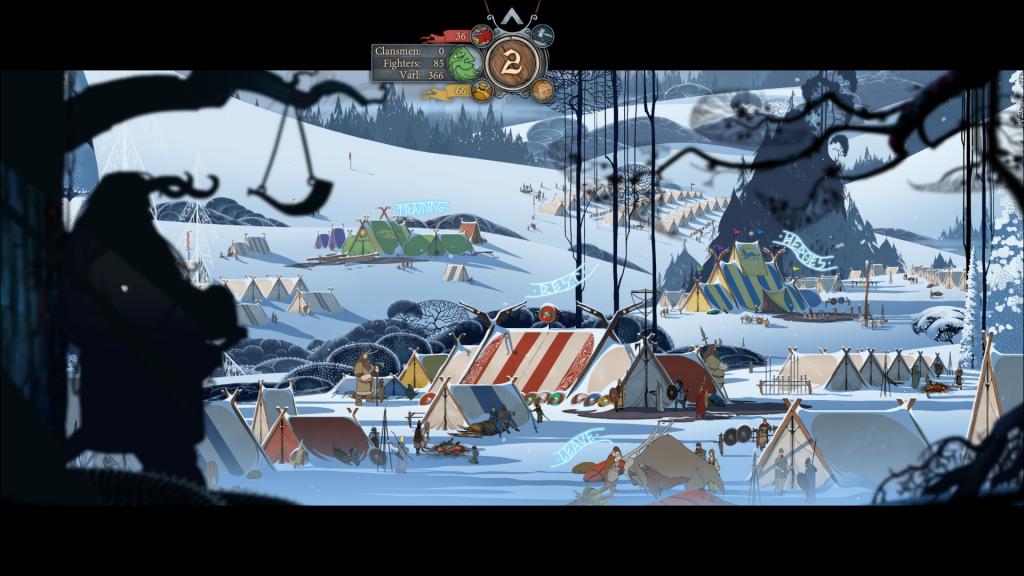
A big part of the game is maintaining supplies for your caravan.
Also, ISN'T IT GORGEOUS. Like OMG I CAN'T EVEN.
If 2014 will be known for one milestone in gaming history, it will be that
it held concrete proof that crowd-funding a game can be successful. Now developers
have options other than going to publishers or releasing games on their own
dime; instead, they can now go directly to the consumer, pitch them an idea and
ask for funding to make it happen. And The Banner Saga is the
poster child of this movement.
Though the Kickstarter campaign for The Banner Saga wrapped up
in March of 2012, it was finally released in January of 2014. Featuring stunning art
inspired by the classic cel-animation style of early Disney films (primarily Sleeping
Beauty) and themes drawn from Norse mythology, the game is an RPG that
jumps between different groups of people trying to survive in a frozen world
invaded by a warlike race known as the Dredge. Together, survivors band
together in a large caravan that traverses the world in an attempt to find and
defeat the Bellower, the leader of the Dredge.
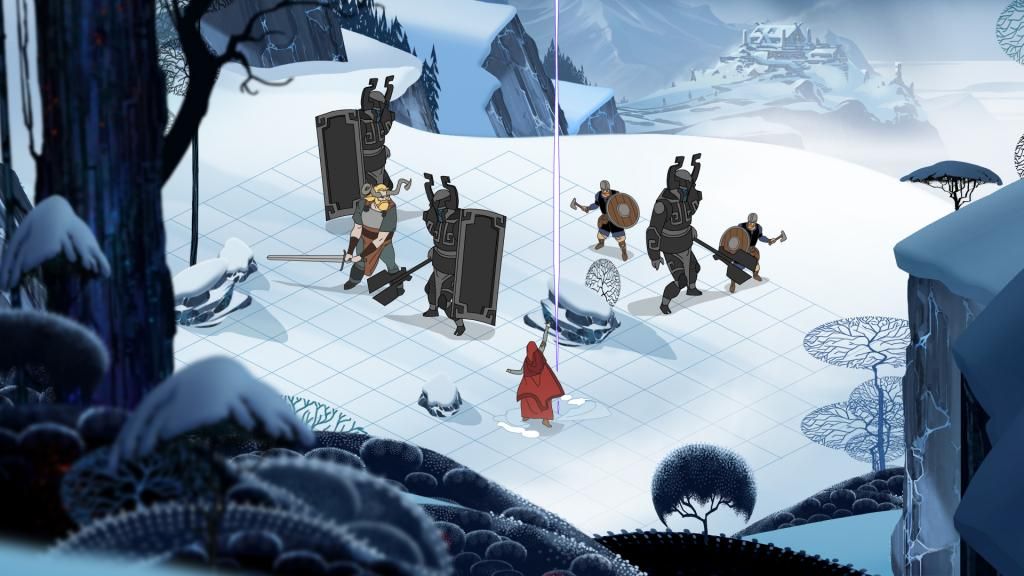
The combat is interesting and tactical, with all manner of
classes to bring with you in battle.
The game has all the staples of a fantastic RPG: likable and relatable
characters; meaningful decisions in the plot; excellent tactical gameplay. The
combat, which is on a grid, can be most closely compared to Final Fantasy Tactics: each character has a certain number of
action points they can spend per turn, and each of their places in initiative
is based on their stats. Combat abilities depend on what sort of weapon the character
fights with and you must be extremely strategic in your choices, as the game is
fairly difficult and will punish you for poor decisions.
If nothing else, The Banner Saga would have been an important
milestone as the realisation of the crowd-funding dream, but it managed to
exceed that already lofty perch to bring a solid gaming experience that is
truly unique and really quite wonderful. In short, The Banner Saga is
a truly excellent game -- and one that I need to return to! Time to add more
cloth to my clan’s banner and save the world from the Dredge!
17. Titanfall (Respawn Entertainment)
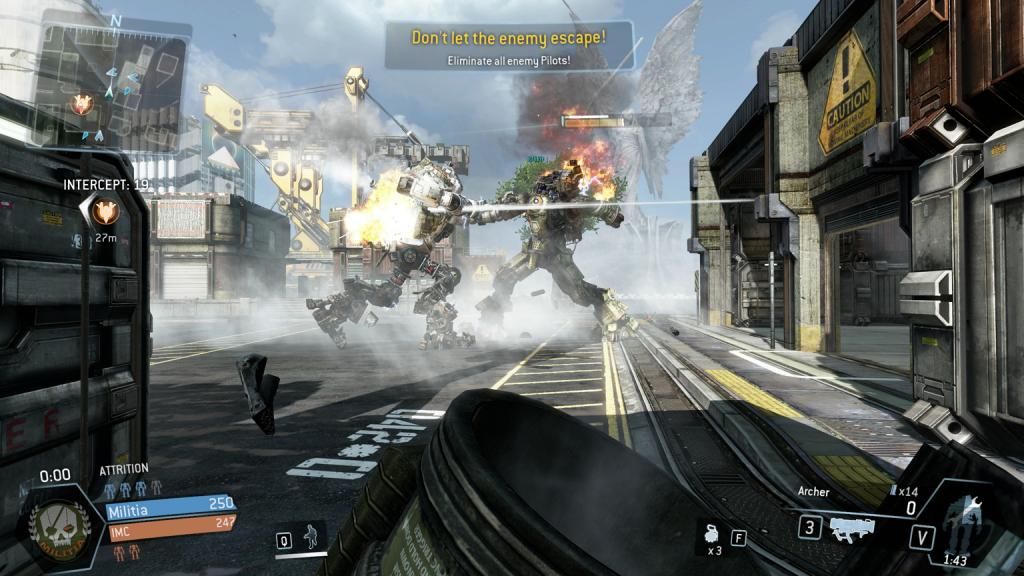
I call this: Carnage.
You remember earlier how I mentioned that, because of the whole Call of
Duty legal thing in 2009, I had put aside money for the first
game to be developed by the studio that formed from the remains of Infinity
Ward? That game was Titanfall -- and man, what a game.
While Call of Duty thrived on the strength of its multiplayer,
it eventually got to the point where the singleplayer content started feeling
tacked on instead of its own feature. Much to their credit, Titanfall avoided
that controversy entirely by eschewing the separation of those two halves and
combined them into a single whole, all the while delivering one of the most
solid shooters I've played in a long time.
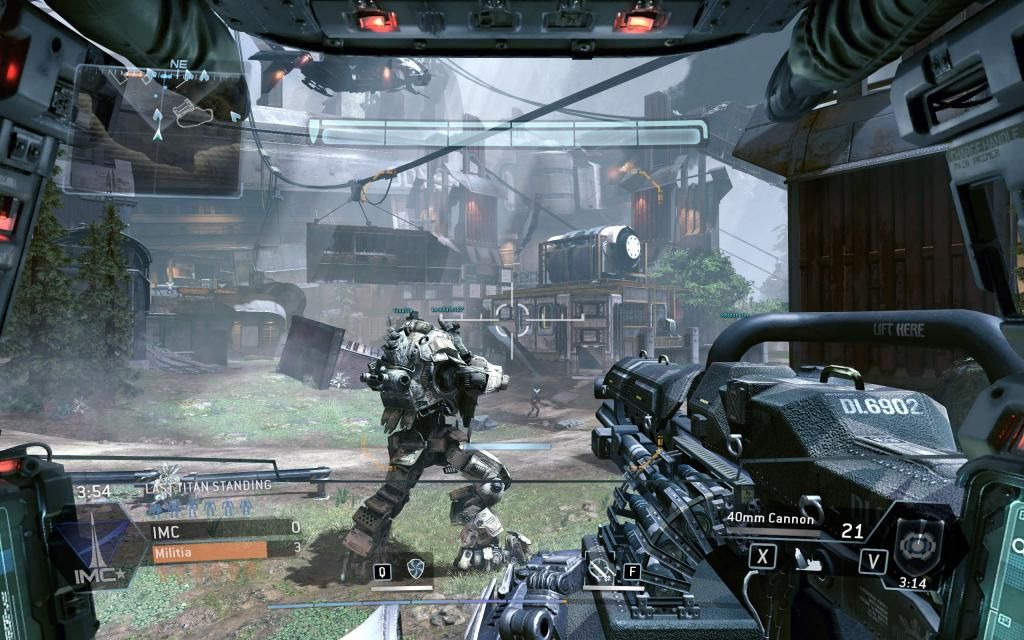
Being inside a Titan is a lot like being on foot, except
the guns you have are bigger than a person. No big deal.
Now let me be honest: the accolades this game received pre-launch concerned
me greatly. It was named Best of Show for E3 2013, a fact that provoked me into
writing
a big rant on the problems inherent with rewarding a multiplayer-only game
in the face of other narrative-driven experiences -- and I stand by that stance.
But what I didn't understand at the time was how well Titanfall would
be able to embrace a hybrid model of gaming, melding a narrative with
multiplayer action. I also didn't understand just how damn fun Titanfall is.
Dynamic action and freedom of movement is the bread and butter of Titanfall;
wall-running, jetpacks, tightly designed maps and the eponymous Titans make
this a shooter that rises above the others. Advanced Warfare tried
to follow their lead but Respawn has set the bar for shooters higher than
ever -- as they did with the evolution of Call of Duty before them.
I am more than excited to see what Respawn does with a sequel for Titanfall,
especially because they have already stated they intend to include a dedicated
singleplayer mode. What little we have seen of the world is intriguing and
compelling, so to extrapolate on that and allow us to explore it? I cannot
wait.
(Way back I did a video commentary on my first match in Titanfall. Check
it out!)
Part Two
Part Two is complete! Part Three will land on Wednesday and with it comes two games that couldn't be more different. Come on back to see what I'm talking about!
Enjoying the list so far? Think I'm completely off my rocker because of how low some of these games are? Drop a comment! Berate me into submission! I'm open to all sorts of conversation so don't be shy! I only bite when I'm hungry, promise.
(Full disclosure: This is mostly inspired by some comments over on an article at Quarter to Three, though it's really been something I've thought about a lot in the last year. Jeez, that makes it sound really important and deep. We're still talking about video games here, folks, don't worry.)
SoRespawn Entertainment, like a phoenix rising from the ashes that used to be Infinity Ward, showed off their new title Titanfall at E3 this year and received huge accolades in the form of six Game Critics Best of E3 awards. (Phoenixes receive awards, right?) For a game developed by a studio that formed out of the legal debacle surrounding Call of Duty: Modern Warfare 2, it's obviously a huge vindication on their part; they parted ways with Infinity Ward and Activision because they sought creative control, respect and recognition (and, very possibly, more money), so being awarded for their newest creation must reinforce that they made the right decision.
But did they deserve the award? To be fair, the footage shown above looks about as stunning as multiplayer can get; the graphics are obviously very well-optimized, the bridging between pure multiplayer and story-based campaign is certainly intriguing and the gameplay itself looks more fluid and entertaining than Call of Duty ever was. But Titanfall is a game that will ship as a multiplayer-only product -- something that was admittedly very common at this year's E3 -- and will not allow offline play because of it.
When DRM (digital rights management) and requisite online connections have become a hot button topic for much of the industry, it seems perhaps a bit ill-conceived to build games on a foundation of "always-online". The Xbox One suffered serious critical panning because of its online-connected requirement; there were other issues -- the inability to share or sell used game discs chief among them, thanks to new DRM -- but the console locking without an online connection was perceived as a huge failing for the new console. Such requirements prevent people from playing offline in any capacity, whether they have a permanently offline console or are simply suffering from a downed internet connection (something which I, and surely many others around the globe, suffer from on a semi-regular and always-infuriating basis). And when something like a quarter of the 360's across the globe are purely offline, you can't blame the negative press Microsoft received.
The much-maligned Xbox One. Hard to imagine this small box
represents such fervent hatred for so many.
Because of those concerns, when the Xbox One was revealed at E3 2013 the consumers were furious. Instantly, Sony wasdeclared thevictor of E3 with the PS4 giving the best showing for hardware. More than a few Microsoft diehards jumped ship and those of us on the fence were quickly blown onto the Sony side. Sony, for their part, approached the rivalry with all the grace of a fifth-grader and actively countered the Xbox One reveal with some pointed statements at their press conference, as well as some entertaining shenanigans after the fact. (Though, to be fair, after the rough competition between the 360 and the PS3, they may be excused for gloating a bit.)
In the face of such fierce adversity and bandwagon-jumping, Microsoft did some backpedaling and made serious alterations to their business model; foremost amongst these changes was that the Xbox One no longer requires a constant online connection and will not lock if not verified in the last 24 hours. They made these changes because the consumers said "No" and Microsoft got scared that they would lose huge revenue from people moving to the PS4. I'm of the opinion that it's too little, too late -- that the damage has been done and Microsoft lost whatever goodwill they had, especially because a lot of the cool features of the Xbox One have also been removed -- but that's neither here nor there; the people spoke and Microsoft reacted and abandoned their always-online components.
A screenshot from the E3 demo of Destiny. This is just after the game
transitioned from a small-party co-op game to a public multiplayer game.
What confuses me, then, is that Microsoft is given an ultimatum because of their always-online requirements but game developers are given a pass on the same issue. At E3 2013, a number of the biggest game titles revealed proved to be multiplayer-only experiences; Titanfall, as mentioned above, along with Bungie's Destiny, Bethesda's Elder Scrolls Online and both The Division and The Crew from Ubisoft are all games that require an online connection to be played, two of which received accolades in the Games Critics Awards. Add to this the games which will focus primarily on multiplayer while still including other content -- Call of Duty: Ghosts, Battlefield 4, Sunset Overdrive, Need for Speed: Rivals -- and it is obvious that gaming content is increasingly shifting focus to multiplayer. Indeed, the biggest buzz at this year's E3 was that the industry was blurring the line between multiplayer and singleplayer; Destiny, The Division and Need for Speed: Rivals (and even games like Watch_Dogs) all have hybrid models that allow you to seamlessly transition from singleplayer to multiplayer and back again, but all require a constant online connection to achieve this content.
So where do we, as consumers, draw the line? If it is not okay for Microsoft to deliver a product that requires a constant online connection, why is the same perfectly fine for other game developers? Is it because it's a hardware versus software issue? I could understand that; it's easier for gamers to avoid online-only games than an online-only console. But it still seems like a very particular stance to take against only half the issue, especially when we award such games as Best of Show.
Or is it because the developers aren't coming out and calling it DRM, like Microsoft and Ubisoft before them? Is it merely the stigma attached with those three letters that sets consumers on the warpath? Because a rose by any other name will still stop you from accessing game content without an online connection. Or something.
In their own way, game developers are taking strides to implement DRM-like requirements for their games. All the games listed above will require constant internet connections to access most, if not all, features included in the game and, regardless of how they explain it, requiring an online connection to access certain content -- or, in some cases, the entire game -- creates a situation very similar to what Microsoft proposed with the original specs for the Xbox One; if you aren't connected, you don't get to play. Yet consumers don't seem to be bothered by this distinction. I understand that the issue may be hardware versus software; at least with an offline console you can play singleplayer games, and you can weigh the options before going for an online-required game. But that's only half the issue and it is confusing that the average consumer is okay with one and not the other.
Brink, despite the middling to poor reviews, was an important stepping stone in the industry, something more evident every day.
Now don't get me wrong: I am excited to see how the industry takes this hybrid model and runs with it. Hell, I lauded the hybrid model as the most important part of Brink, a game that I thoroughly enjoyed in spite of its shallow content. There is so much potential for new gameplay, and it makes the game that much more engaging when you know you are dealing with both the computer AI as well as a third, user-controlled party, or (especially) when you are experiencing a narrative alongside your friends. Brink did a fantastic job with this, allowing their game to slide seamlessly between singleplayer, cooperative play and competitive multiplayer, in whichever direction you choose, with little more than a few button presses. But where Brink failed was in creating a compelling narrative in-game and providing content that would be experienced differently with or without people, and that is what concerns me most.
In implementing such a hybrid system, it will be easier for games to move away from narrative and towards an experience focused more on the instant gratification of Call of Duty-esque multiplayer. Destiny captured my attention because, though it is a multiplayer online-only experience, there is a narrative structure for the whole game, complete with dialogue and cutscenes. It is a game that you could easily imagine playing solo without having to rely on -- or be wary of -- other people to have fun. It is the same reason I so thoroughly enjoy Star Wars: The Old Republic while I find other MMOs stale and boring; TOR weaves a narrative around your character and provides you with compelling reasons to continue playing, even if it does boil down to fetch quests. And sure, you can group up or do some of the Flashpoints (because 'Instance' and 'Raid' are too WoW, apparently) but you don't have to in order to have a good time.
The Division was gorgeous, had a great premise and looks
incredibly fun. But will it have a narrative to experience and follow?
In comparison, Titanfall offered only the barest of story moments -- some lady yelling a briefing at you before you start the match? -- and The Division looked like a game entirely based on emergent gameplay where the only story is the one that you and your friends create by playing. Yes, we saw evidence of scripted moments -- the officer in the mech giving quick orders on landing, the police sharing information after having been rescued -- but there was no evidence of any sort of overarching plot in either game. We obviously haven't seen enough content from either title to make too many assumptions but when compared to Destiny, a game that has been showcasing the narrative side of the experience, it is hard not to wonder. And, though you may be able to play The Division without others in your group, Titanfall will not function unless you have a balanced complement of players on either team.
It's a bit of a catch-22, of course, because in some cases focusing only on multiplayer might be for the best. This is especially true with games like Titanfall: Vince Zampella, the head of Respawn Entertainment, has explicitly stated that the developers focused on multiplayer in order to better utilize their development assets. It might seem like a cop-out to focus on multiplayer when a campaign is usually so important but I admire the decision. By cutting out one of the two parts, the developers can then focus on making the best possible game they can without having to split resources. It takes guts to turn away from such a tried-and-tested formula; I admire that Respawn made the tough call and stuck with what they know best. Team Fortress 2 and League of Legends, two huge multiplayer-only games, are great go-to games for me and neither would work as a singleplayer game. But I wouldn't give either of them a Best of Show award, no matter how much I like them, and I don't think Titanfall deserved it for the same reason: multiplayer-only games, while replayable, are neither recognizable nor memorable in the long-term.
Will Titanfall, a game solely devoted to multiplayer action, be able
to tell a compelling and interesting story in spite of its focus?
I and many others like me -- my fiancée chief among them in my life -- play games to experience a story, to inhabit a character, whether of our creation or the developers', and see the story that they will tell. To people like us, the narrative is the most important piece. Games like Heavy Rain, Bioshock, Shadow of the Colossus, Bastion, The Last of Us, Mass Effect; they all, first and foremost, tell a story. The gameplay, while still important, comes second to that -- and there are developers that understand that fact. But now the norm is shifting; multiplayer has become more important, gameplay is king and, more often than not, the narrative side of things suffers. And now we have rewarded a multiplayer-only title with a Best of Show award? I'm concerned it sets a poor precedent for developers will influence their decisions the next time a game is pitched.
(For the record, I don't have anything against Titanfall; it fills a demand in the industry, looks gorgeous and will be a very entertaining game, I'm sure. And, despite all my concerns, I'm hopeful that Respawn will prove me wrong and deliver both on gameplay and narrative. This might be because I swore to buy the first game Respawn developed -- I saved what money I would have spent on Black Ops and devoted it to the future Respawn game -- so they will get my money regardless. But it would be nice to have my concerns washed away.)
So again I ask: where do we, as consumers, draw the line? When does online-required content become an issue for games, or will it ever? Is it right that we've decided multiplayer-only games are the height of the industry standard? Will the push for a hybrid model of gaming become the new norm? These are tough questions to answer -- even I'm not sure where I fall on some of them -- but they will ultimately decide the direction the industry heads. And if this trend continues, and all of our narrative content gets mashed together with multiplayer gameplay, I hope that the developers can still create stories as compelling as the industry expects today.
For now? Just give me Watch_Dogs and Beyond: Two Souls and let me have my solo campaign fun.